
2-1 Mortgage Buydowns: A Guide for Buyers and Sellers

By Diane Casey Luong
Mortgage Rate Buydowns: A Smart Conversation for Home Buyers and Sellers
A compelling home price gets attention, but a manageable monthly payment can help buyers move forward. For sellers, pairing a market-supported asking price with a negotiated mortgage buydown may make a home more appealing. For buyers discouraged by a 30-year mortgage rate of 6.8%, a seller-funded 2-1 buydown can lower their payments during the first two years, giving them breathing room as they settle in. The key is understanding both the early savings and the full payment that follows.
What Is a Seller-Funded 2-1 Mortgage Buydown?
A 2-1 buydown is a temporary payment subsidy. The seller contributes money at closing to cover part of the buyer’s mortgage payments for two years.
With a 30-year fixed mortgage at 6.8%, the buyer’s principal-and-interest payments are calculated as though the rate were:
- 4.8% in year one, two percentage points below the note rate.
- 5.8% in year two, one percentage point below the note rate.
- 6.8% in years three through 30, the full contractual payment.
The mortgage’s actual fixed interest rate remains 6.8% throughout. The subsidy account pays the difference between the buyer’s reduced contribution and the scheduled mortgage payment. This is different from paying discount points to permanently lower the loan’s rate.
For eligible Fannie Mae loans, borrowers must qualify at the full note rate. A buydown helps with early cash flow; it does not replace the ability to afford the long-term payment.

YEAR 1
$2,224.58 per month with the buydown
Standard mortgage: $2,764.16 per month
Monthly payment relief: $539.58
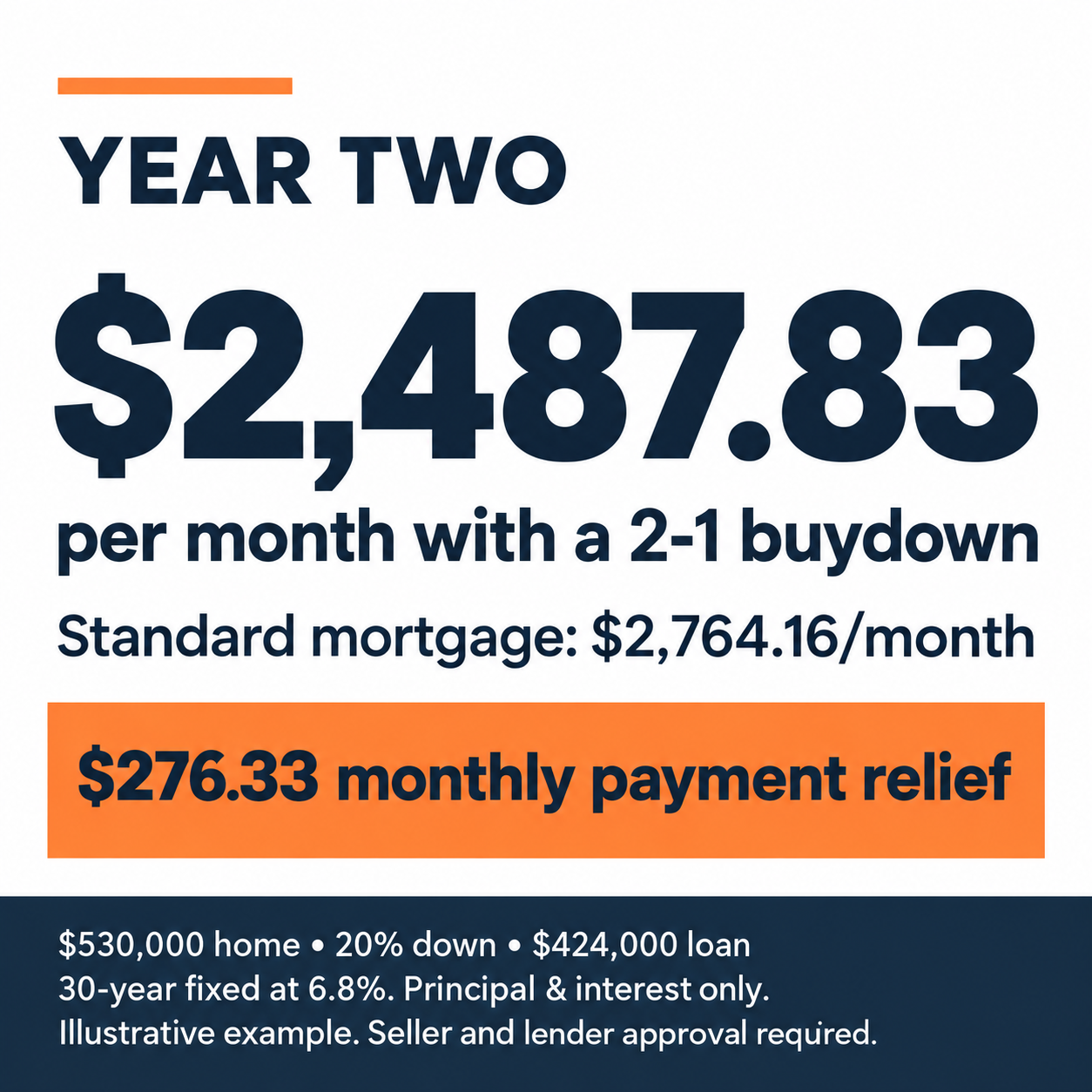
YEAR TWO
$2,487.83 per month with the buydown
Standard mortgage: $2,764.16 per month
Monthly payment relief: $276.33
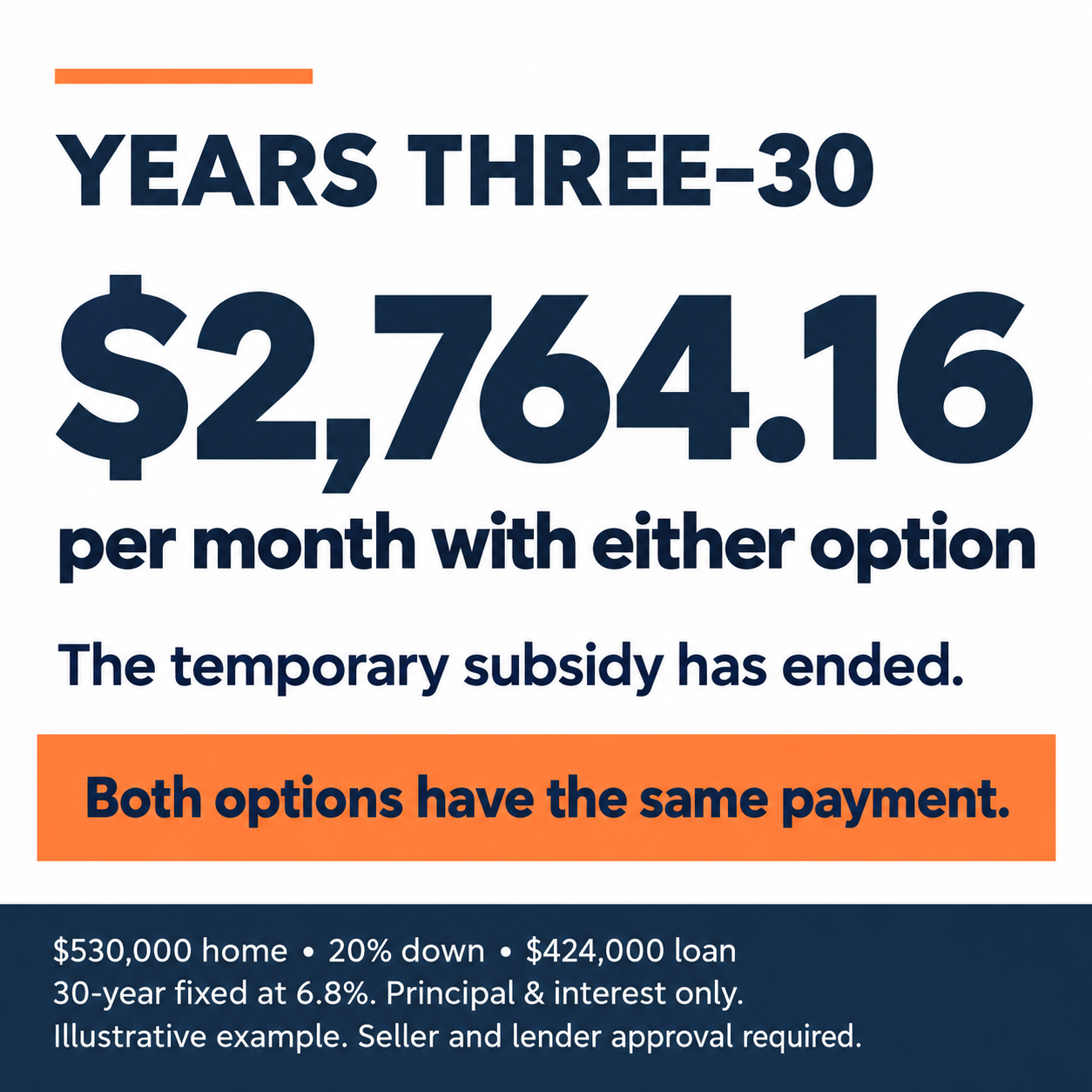
YEARS THREE–30
$2,764.16 per month
Both options have the same principal-and-interest payment after the temporary subsidy ends.
What Happens Over the Full 30 Years?
The Numbers: A Standard 30-Year Mortgage vs. a Seller-Funded 2-1 Buydown
Assumptions for This Comparison
Both options use the same purchase price, down payment, loan amount, and fixed note rate:
| Item | Assumption |
|---|---|
| Purchase price | $530,000 |
| Down payment | $106,000, or 20% |
| Mortgage amount | $424,000 |
| Loan term | 30 years, or 360 monthly payments |
| Fixed note rate | 6.8% |
| Seller-funded buydown | Two percentage points in year one; one point in year two |
These are principal-and-interest estimates only. Property taxes, homeowners insurance, closing costs, HOA fees if applicable, and any mortgage insurance are additional. The 6.8% rate is an illustration, not a current lender quote or APR. A conventional loan with 20% down generally does not require PMI.

STANDARD MORTGAGE
Total buyer principal-and-interest payments: $995,098.61

WITH A SELLER-FUNDED 2-1 BUYDOWN
Total buyer principal-and-interest payments: $995,098.61
Total buyer principal-and-interest payments: $985,307.67
Seller contribution: $9,790.94
Assumes the loan is held for all 30 years with no refinancing or extra payments. The subsidy changes who pays part of the cost; total interest charged on the loan remains the same.
Monthly Payments and First-Two-Year Savings
The buyer contributes approximately $6,474.98 less in year one and $3,315.96 less in year two, for a combined $9,790.94 in payment relief.
That is money the buyer could keep available for moving expenses, repairs, emergency savings, or other household priorities.
The step-ups also deserve attention. The buyer’s principal-and-interest payment rises approximately $263.25 per month at the start of year two, then another $276.33 at the start of year three. Taxes and insurance can change separately.

Your Total Two-Year Payment Relief
$9,790.94
That’s approximately $6,475 in the first year and $3,316 in the second, funded by the seller through a negotiated concession.
Example assumes a $530,000 purchase, 20% down, and a $424,000 mortgage with a 6.8% fixed note rate. Payments include principal and interest only. Seller participation and lender approval are required.
The buyer’s financial benefit is approximately $9,790.94, funded by the seller and concentrated in the first two years. The buydown does not reduce the loan’s contractual interest charges or change its scheduled principal balance.
The seller’s contribution is a real transaction cost. At a $530,000 sale price, a $9,790.94 subsidy leaves approximately $520,209.06 before commissions, other closing costs, and mortgage payoff.
Figures use unrounded mortgage calculations and are rounded for display. Lender schedules may differ slightly.
For Sellers: Compare a Price Reduction With a Payment Incentive
The recent reduction from $535,000 to $530,000 lowers the purchase price permanently.
With 20% down at both prices, that $5,000 reduction means:
- A $1,000 smaller down payment.
- A $4,000 smaller mortgage.
- Approximately $26.08 less per month in principal and interest at 6.8%.
By comparison, the proposed 2-1 buydown at $530,000 delivers approximately $539.58 in monthly relief during year one and $276.33 during year two.
Those are different benefits at different costs. The $5,000 price reduction does not fully fund the approximately $9,791 buydown. Offering both would require an additional seller concession.
For a closer budget comparison, a seller with a $5,000 concession budget could ask the lender to quote a smaller temporary subsidy, closing-cost assistance, or permanent discount points. The best choice depends on what buyers need and what the seller can accept.
A buydown can strengthen a well-priced listing’s appeal, particularly for buyers concerned about early payments. Pricing still needs to reflect comparable sales, condition, and the appraisal.
For Buyers: Consider the Rate Alongside the Entire Purchase
An interest rate does not have to end the homebuying conversation. If the home fits your needs and the full payment fits your budget, a seller-funded 2-1 buydown can make the transition into ownership easier. During that period, you can also watch for an opportunity to refinance if rates decline and you qualify. Refinancing is available to eligible borrowers with either loan structure; the buydown provides early payment relief while you evaluate that possibility.
Buy based on the payment you can afford without refinancing. Lower future rates are not guaranteed. Refinancing requires a new approval, can involve closing costs, and may increase lifetime interest if you extend repayment.
Before refinancing, compare the new payment with the full existing payment, account for any remaining subsidy, and calculate how long the savings would take to recover the refinancing costs.
How to Put a Buydown Into a Purchase Conversation
Buyers can ask their agent to explore a seller contribution and have a lender provide a written comparison of the standard mortgage, temporary buydown, and other uses of the same credit.
Sellers can ask their agent and a participating lender to estimate the concession required and compare the resulting net proceeds with a price reduction.
For either side, confirm the payment schedule, total housing costs, permitted seller contributions, and treatment of unused funds before agreeing to terms. Seller-funded buydowns are subject to loan-program rules and contribution limits.
Considering a purchase or sale in Sutton or Central Massachusetts? Let’s compare the asking price, monthly payment, and available financing strategies so you can make an informed decision.
Frequently Asked Questions
1. How does a 2-1 buydown affect the potential of having to also have PMI? Does it negate it, alter how much it will be, or have no effect at all?
A 2-1 buydown does not, by itself, eliminate PMI or lower its premium. It does not count as a down payment or reduce the loan-to-value ratio. On a conventional mortgage, PMI is generally required with less than 20% down, and its cost depends on the insurer’s pricing and borrower and loan characteristics.
At $530,000, a 10% down payment would be $53,000, leaving a $477,000 mortgage. The illustrative principal-and-interest payments would be approximately $2,502.65 in year one, $2,798.81 in year two, and $3,109.68 thereafter, plus applicable PMI, taxes, and insurance. Ask the lender to quote PMI separately. FHA mortgage insurance follows different rules.
2. Is a 2-1 buydown an adjustable-rate mortgage?
No. In this example, it accompanies a 30-year fixed-rate mortgage. The note rate stays at 6.8%; the seller’s subsidy temporarily reduces the buyer’s payment contribution.
3. Does the seller have to agree to fund a buydown?
No. It is negotiated as part of the transaction and requires lender approval. The seller may prefer a price adjustment or another concession. Permitted contributions also depend on the mortgage program.
4. What happens if I refinance or sell before the two years end?
The written agreement and program rules control the remaining funds. For Fannie Mae loans, unused funds may be credited toward payoff or returned as the agreement permits. Do not assume you will receive a cash refund.
5. What if mortgage rates do not fall before the buydown ends?
The subsidy ends, and you pay the full scheduled principal-and-interest payment. In this example, that is approximately $2,764.16 per month starting in year three, plus taxes, insurance, and other applicable charges. Plan for that payment from the beginning.
Educational illustration, not a loan offer. Financing eligibility, rates, fees, and seller concessions require lender confirmation.
Disclaimer: The information provided in this blog is for informational purposes only and should not be considered legal, financial, or real estate advice. All data is deemed reliable but is not guaranteed and may be subject to change. Please consult a licensed real estate professional, financial advisor, or legal expert for personalized advice regarding your situation. Equal Housing Opportunity.
Sources:
- 9 Colonial Road property details and price history: https://www.realtor.com/realestateandhomes-detail/9-Colonial-Rd_Sutton_MA_01590_M37963-57301
- Fannie Mae temporary interest rate buydown guidelines: https://guide-selling.fanniemae.com/sel/b2-1.4-04/temporary-interest-rate-buydowns
- CFPB explanation of private mortgage insurance: https://www.consumerfinance.gov/ask-cfpb/what-is-private-mortgage-insurance-en-122/
- Federal Reserve refinancing guide: https://www.federalreserve.gov/pubs/refinancings/default.htm
Sources checked October 19, 2026. Calculations use the standard fixed-payment formula: M = P × r ÷ [1 − (1 + r)^−360], where r is the monthly rate. Temporary buyer contributions use 4.8% and 5.8% over the original 360-month term; the note amortizes at 6.8%.
Recent Post
45 Indian Hill Rd, Worcester, MA – $449,900
Back on the market and ready for its next owner! This spacious Indian Hill ranch offers one-level living, hardwood floors, two fireplaces, a finished lower level with ADU potential, a two-car garage, and a beautiful half-acre lot.
29-A Chilmark St, Worcester, MA – $300,000
Enjoy low-maintenance living just steps from Shrewsbury Street. This updated 2-bedroom townhome features energy-efficient heat pumps, hardwood floors, composite deck, garage, and a prime location near UMass Chan Medical School, hospitals, and Worcester’s popular Restaurant Row.
Social Updates

Contact
Diane Casey Luong
RE/MAX Vision
25 Union Street
4th Floor
Worcester, MA 01608
774-239-2937
diane@dianesmybroker.com
Buying/Selling
Resources





Author: dianesmybroker
Just a guy living his best life backwards.